There is a strange pattern I have seen many times in real life, especially in technical discussions, architecture debates, management conversations, and even simple day-to-day arguments. Sometimes the person who knows the least speaks with the most confidence.
And sometimes the person who has deep experience, who has spent years studying and working with a subject, speaks more carefully. They pause. They qualify their statements. They say things like:
"It depends."
"There are trade-offs."
"I would need more context."
"I know this part well, but there are still things I am not fully sure about."
At first glance, this looks backwards. We expect knowledge to create confidence. And yes, to some extent it does. But real knowledge also does something else: it shows us the size of the unknown.
The more we learn, the more we see how much more there is to learn.
This is where the Dunning-Kruger effect and the circle of knowledge model become very useful.
- The Basic Idea
- What Dunning and Kruger Actually Studied
- The Circle of Knowledge Model
- Stage 1: The Dot — "I Know Everything"
- Stage 2: The Small Circle — "I Understand Most of It"
- Stage 3: The Growing Circle — "The More I Learn, the More Questions I Have"
- Stage 4: The Large Circle — "I Finally Understand How Much I Still Don't Know"
- Why Beginners Often Sound More Certain Than Experts
- The Circle Model in One Simple Summary
- Why This Matters in Real Life
- The Practical Lesson
- Final Thought
- Sources and Further Reading
The Basic Idea
The simple version is this:
People with low competence often overestimate their ability, while people with higher competence are usually more aware of the limits of their knowledge.
This idea is commonly linked to the research of psychologists David Dunning and Justin Kruger, who published a famous paper in 1999 called "Unskilled and Unaware of It".
Their research showed that people who performed poorly in certain tasks often believed they performed much better than they actually did. The problem was not just that they lacked skill. The deeper problem was that they also lacked the ability to accurately judge their own lack of skill.
That is the brutal part.
To know that you are bad at something, you often need enough knowledge to understand what "good" actually looks like.
If you do not have that knowledge, your self-assessment is broken from the beginning.
What Dunning and Kruger Actually Studied
Dunning and Kruger tested people in areas such as logic, grammar, and humour. Participants completed tasks and were then asked to estimate how well they had performed compared with others.
The pattern was clear:
- People who scored poorly often dramatically overestimated their performance.
- People who scored well were usually more accurate, and sometimes underestimated how much better they were than others.
- The weakest performers lacked not only competence, but also the ability to recognize their own mistakes.
This does not mean that every beginner is arrogant or every expert is insecure. That would be too simplistic.
The real point is more precise:
Low competence can damage self-awareness.
When someone does not understand a subject deeply, they often cannot see the hidden complexity. They do not see the edge cases. They do not know the history of failed approaches. They do not understand why experienced people are cautious.
So they feel certain.
Not because they are right, but because they cannot yet see enough to know they might be wrong.
The Circle of Knowledge Model
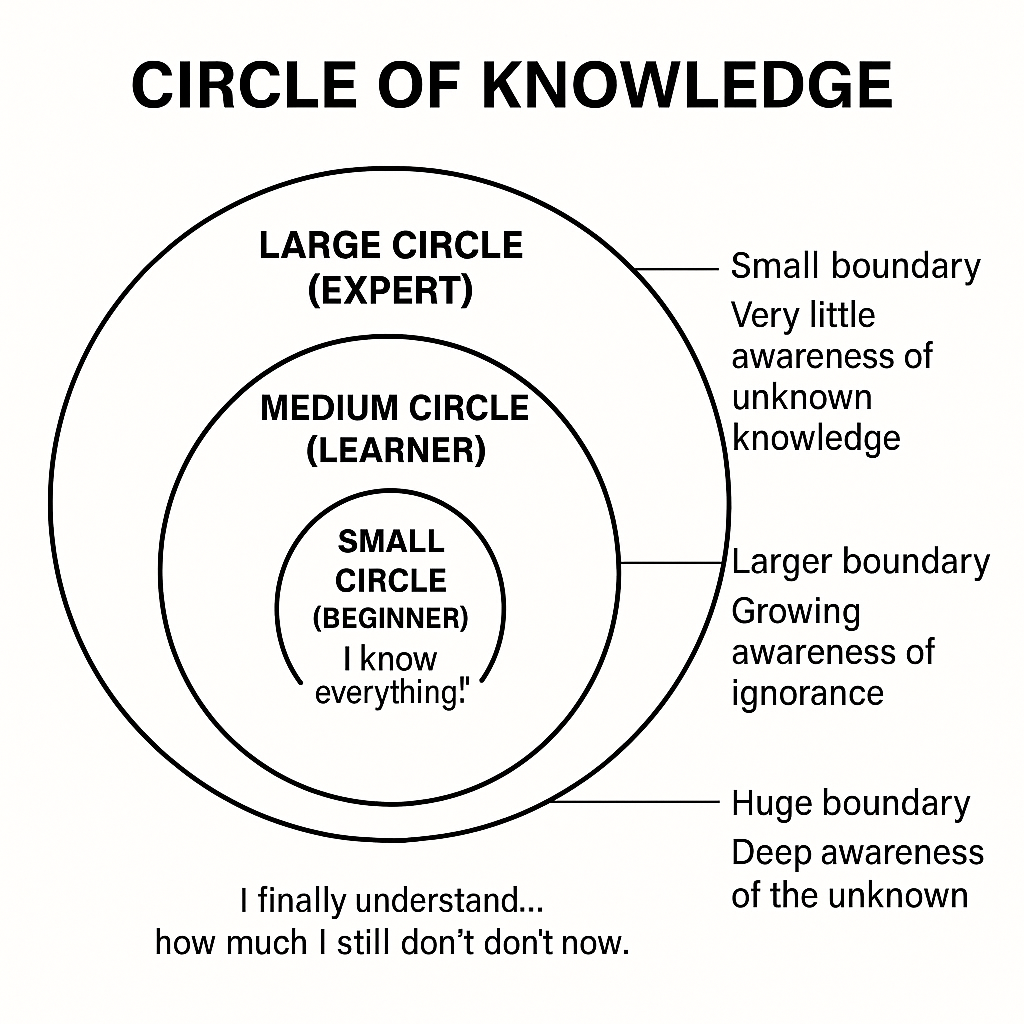
A simple way to explain this is to imagine knowledge as a circle.
Inside the circle is everything a person knows.
The edge of the circle is the boundary between what the person knows and what the person does not know.
Outside the circle is the enormous world of unknown knowledge.
This model is powerful because it explains why learning can sometimes make us feel less confident, not more.
Stage 1: The Dot — "I Know Everything"
At the very beginning, a person's knowledge is almost like a dot.
There is nearly no area inside the circle because the person knows very little.
But there is also almost no boundary.
And that is the problem.
If there is no boundary, there is very little contact with the unknown. The person does not yet see the size of the subject. They do not see the complexity. They do not see the exceptions. They do not see the hidden traps.
From inside that tiny dot, the world feels simple.
This is why a complete beginner can sometimes say things like:
"This is easy."
"Why don't they just rewrite it?"
"The architecture is obvious."
"I can build this in a weekend."
"Experts are overcomplicating it."
This is not confidence built on mastery. This is confidence built on missing context.
In software development, this is extremely common. A junior developer may look at a large system and say, "This is trash, we should rebuild it." Sometimes they might even be right. But often they do not yet understand the dependencies, business rules, legacy integrations, operational constraints, security requirements, data migration problems, or political reality around that system.
They see the code.
They do not yet see the battlefield.
Stage 2: The Small Circle — "I Understand Most of It"
After learning a little, the dot becomes a small circle.
Now the person knows more. They have some real knowledge. They understand some terminology. They can explain basic concepts. They can solve basic problems.
But the boundary is still small.
That means their awareness of the unknown is also still limited.
This stage can be dangerous because the person now has enough knowledge to sound convincing, but not enough knowledge to be careful.
This is the stage where people often become loud.
- They know enough to argue, but not enough to doubt themselves.
- They have learned the happy path, but not the failure modes.
- They know the framework, but not the production consequences.
- They know the pattern, but not when the pattern becomes a liability.
- They know the rule, but not the exceptions.
This is often where overconfidence becomes most visible.
Stage 3: The Growing Circle — "The More I Learn, the More Questions I Have"
When the person keeps learning, the circle grows.
This is where the model becomes interesting.
As the circle grows, the area inside the circle becomes larger. That means the person really does know more.
But the boundary also becomes larger.
That larger boundary means the person now has more contact with the unknown.
They begin to discover how large the subject really is. They start to see contradictions, trade-offs, edge cases, and context. They start to understand that many simple answers are simple only because they ignore half of the real problem.
This is where confidence often drops.
Not because the person became stupid.
Because the person became aware.
They now understand enough to know that the topic is deeper than it looked from the outside.
In software architecture, this is where someone stops saying:
"Just use microservices."
And starts saying:
"What are the team boundaries, deployment constraints, data ownership rules, transaction requirements, monitoring capabilities, failure recovery expectations, and operational maturity?"
That is a very different level of thinking.
Stage 4: The Large Circle — "I Finally Understand How Much I Still Don't Know"
An expert has a much larger circle.
They have more knowledge, more experience, more pattern recognition, and more scars from real-world mistakes.
But their boundary with the unknown is also huge.
They know enough to see how many things they still do not know.
This is why true experts are often careful with their language.
They are not weak. They are not confused. They are not lacking confidence.
They are accurate.
- They know that reality is complicated.
- They know that a solution that works in one company may fail in another.
- They know that a technology that looks perfect in a demo may become painful in production.
- They know that most strong opinions need context.
- They know that "best practice" often means "best practice under a specific set of constraints."
This is not insecurity.
This is maturity.
Why Beginners Often Sound More Certain Than Experts
A beginner sees a small part of the problem and thinks it is the whole problem.
An expert sees the same part, but also sees everything connected to it.
That is why the expert's answer often sounds less dramatic:
"It depends."
Many people hate that answer. They think it is avoidance.
But in complex systems, "it depends" is often the most honest answer.
The real value comes after that:
"It depends on these specific things, and here is how I would evaluate them."
That is the difference between vague uncertainty and professional judgement.
A weak thinker hides behind "it depends."
A strong thinker uses "it depends" to expose the real decision factors.
The Circle Model in One Simple Summary
Imagine three people looking at the same topic.
The Beginner
Their circle is tiny. They say:
"I know everything."
But they say it because they have almost no boundary with the unknown. They do not know what they do not know.
The Learner
Their circle is growing. They say:
"This is more complicated than I thought."
They are beginning to see the unknown. This is a healthy stage.
The Expert
Their circle is large. They say:
"I know a lot, but I also see how much more there is."
They are not less competent. They are more aware. Their humility is not a lack of knowledge — it is a side effect of real knowledge.
Why This Matters in Real Life
This idea matters because overconfidence is expensive.
- In business, overconfident people make bad strategic decisions.
- In software, overconfident people create fragile architectures.
- In management, overconfident people ignore risks until those risks become incidents.
- In projects, overconfident people promise timelines without understanding complexity.
- In leadership, overconfident people confuse certainty with competence.
And this is dangerous.
Because confidence is easy to fake. Competence is not.
A person who speaks loudly, quickly, and with no doubt may look strong in a meeting. But if their confidence is not backed by depth, they can lead the whole team into a bad decision.
This is why experienced leaders and architects must learn to separate confidence from capability.
They are not the same thing.
The Practical Lesson
The goal is not to become permanently doubtful. That would be useless.
The goal is to build calibrated confidence. That means:
- Be confident where you have real evidence.
- Be cautious where you have limited context.
- Be honest about assumptions.
- Ask better questions.
- Look for hidden complexity.
- Respect people who understand the details.
- Do not mistake simplicity for correctness.
The best experts are not people who say, "I know nothing."
They are people who can clearly explain:
"Here is what I know. Here is what I assume. Here is what I don't know. Here is what we need to validate."
That is real professional thinking.
Final Thought
The circle of knowledge is a simple model, but it explains something very important.
When your circle is small, the unknown feels small.
When your circle grows, the unknown becomes visible.
That is why learning can sometimes feel uncomfortable. You start with confidence, then you hit complexity, then you feel uncertainty, and only later do you build real judgement.
So if the more you learn, the more you feel there is still much more to understand — that is not a failure.
That is growth.
Your circle is expanding.
And the expanding circle is where real wisdom begins.
Sources and Further Reading
- David Dunning and Justin Kruger, "Unskilled and Unaware of It", Journal of Personality and Social Psychology, 1999: doi.org/10.1037/0022-3514.77.6.1121
- Britannica, Dunning-Kruger effect: britannica.com/science/Dunning-Kruger-effect
- The Decision Lab, Dunning-Kruger Effect: thedecisionlab.com/biases/dunning-kruger-effect
💬 Comments & Reactions